


All Blogs
BS 1710 Colour Chart & Pipe Marking Compliance Guide UK

Oct
Navigating industrial safety requires a clear BS 1710 colour chart to identify services correctly. Consequently, this guide provides an essential BS 1710 colour chart reference and an overview of UK pipe marking regulations. Furthermore, following these standards keeps your facility compliant and your team safe.
For those ready to implement these standards, you can find the full range of compliant Pipe Identification Paint here.
Understanding Pipe Colour Coding Regulations in the UK
The primary regulation governing UK pipelines is BS 1710:2014. Specifically, this standard works alongside the Health and Safety (Safety Signs and Signals) Regulations 1996. These laws mandate that facilities must clearly identify all hazardous contents in pipes.
Adhering to these pipe colour coding regulations provides a critical safety measure. For instance, correct identification prevents cross-contamination and assists emergency services. Most importantly, it ensures maintenance teams work safely without the risk of accidental discharge.
Why Proper Pipe Identification Prevents Accidents and Improves Efficiency
In a high-pressure environment, split-second decisions save lives. Improperly labeled pipes cause many workplace accidents, such as chemical burns or explosions. However, you can eliminate this “guesswork” by following a strict BS 1710 colour chart.
Operational Efficiency Benefits
Clear pipe marking standards UK drive significant bottom-line improvements. For example, maintenance teams trace lines instantly, which reduces downtime. Additionally, first responders isolate leaks faster during an emergency. Because of this clarity, new staff members navigate infrastructure with minimal supervision.
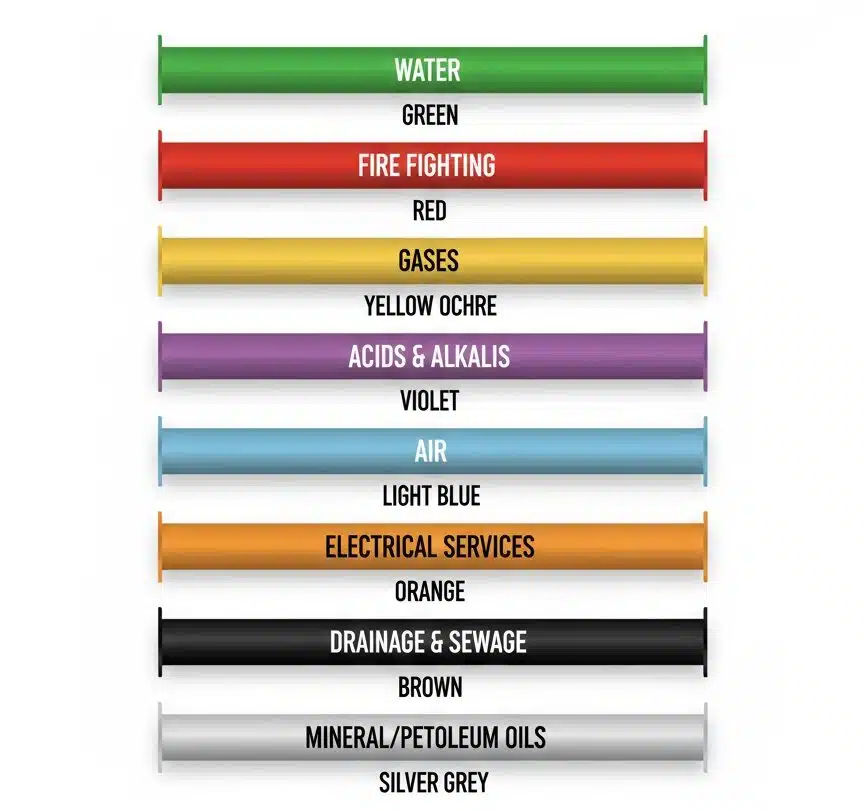
BS 1710:2014 Pipe Marking Colour Chart & Reference Guide
| Pipe Content | Basic Identification Colour | BS 4800 Colour Code | Safety/Service Colour |
| Water (Potable) | Green | 12 D 45 | Blue (Auxiliary) |
| Water (Non-Potable) | Green | 12 D 45 | Flint Grey / Black |
| Natural Gas | Yellow Ochre | 08 C 35 | None (Standard) |
| Oils (Mineral/Fuel) | Brown | 06 C 39 | None (Standard) |
| Air | Light Blue | 20 E 51 | None (Standard) |
| Steam | Silver-Grey | 10 A 07 | None (Standard) |
| Acids & Alkalis | Violet | 22 C 37 | None (Standard) |
| Fire Extinguishing | Red | 04 E 53 | None (Standard) |
Essential Pipe Marking Standards: A BS 1710:2014 Checklist
To ensure your facility meets the latest pipe marking standards UK, use this compliance checklist:
- Primary Identification: Does every pipe have a base identification colour applied to its entire length or in distinct bands?
- Secondary Identification: Are hazardous substances marked with additional safety colours or information bands (e.g., radioactive, biological, or flammable)?
- Flow Direction: Are arrows clearly visible to indicate the direction of the fluid or gas flow?
- Durability: Is the marking system (paint or tape) resistant to the environment, including heat, chemicals, and UV exposure?
- Standard Reference: Does your colour palette strictly match the BS 4800 colour coordinates specified within BS 1710?
How to Identify Pipes in Facilities: Placement and Frequency
Correct placement is just as important as the colour itself. To remain compliant, markings should be applied:
- At junctions and valves: Where flow can be diverted or controlled.
- Wall penetrations: On both sides of any wall, floor, or ceiling the pipe passes through.
- Regular Intervals: On straight runs, markings should be placed every 3 to 5 metres to ensure visibility from any standpoint.
- Bulk Storage: Near any entry or exit point of a storage tank or pressure vessel.
Pipe Identification Product Range from Palatine Paints
While this guide focuses on pipe colour coding regulations, the durability of the marking is just as critical as the colour itself. Palatine Paints provides a specialized range of coatings designed to meet BS 4800 specifications while withstanding the rigours of industrial use.
Our range includes:
-
High-Gloss Alkyd Enamels: Ideal for general-purpose identification with excellent colour retention.
-
Heat-Resistant Coatings: Specifically formulated for steam and high-temperature fluid lines.
-
Chemical Resistant Epoxies: Designed for environments exposed to aggressive cleaning agents.
View the full Pipe Identification Paint collection to find the right match for your facility.
Application Methods for Different Pipe Materials and Environments
How you apply Pipe Identification Paint depends heavily on the substrate:
- Metal Pipes (Steel/Copper): Require a dedicated primer to prevent corrosion. Ensure the surface is degreased before applying the BS 1710 colour.
- Plastic/PVC Pipes: Require a “high-grab” primer or specialist coating that won’t degrade the plastic over time.
- High-Moisture Areas: In cooling plants, we recommend a polyurethane topcoat to prevent UV fading and moisture ingress.
Custom Formulation Options for Specialized Pipe Identification Requirements
Palatine Paints offers custom formulation options for specialized projects, including:
- Specific RAL or BS Matches: For facilities with unique internal standards.
- Multiple water circuits (chilled, hot, potable, process)
- Various compressed gas systems
- Chemical feed systems
- HVAC distribution

Expert Surface Preparation for Best Results
To ensure the BS 1710 colour chart remains visible, you must prepare the surface correctly. Otherwise, the paint may flake or peel.
Cleaning and Priming Bare Metal
First, use a high-quality degreaser to remove all traces of oil. Next, lightly abrade the surface with sandpaper to create a “key.” Finally, we recommend using Carboxide Anti-Corrosive Metal Primer. This primer provides a rust-inhibiting foundation that ensures your BS 4800 colours stay vibrant and bonded.
How to Position Pipe Identification Markers
When you use a BS 1710 colour chart, you must also consider placement. To remain compliant, apply markings at these specific points:
-
Junctions and Valves: Where the flow diverts or stops.
-
Wall Penetrations: On both sides of any wall the pipe passes through.
-
Regular Intervals: On straight runs, place markings every 3 to 5 metres.
Why use Carboxide for Pipe Identification?
- Corrosion Resistance: It contains active anti-corrosive pigments that prevent rust from forming under the identification paint—essential for pipes carrying cold fluids that may suffer from surface condensation.
- Superior Adhesion: It creates a chemical bond with the metal, ensuring that the BS 1710 identification bands do not peel even in high-vibration environments.
- High Opacity: The primer provides a solid, neutral base that ensures the final BS 4800 colours (like Yellow Ochre or Green) appear accurate and vibrant with fewer coats.
- Versatility: Suitable for use under both gloss and satin topcoats.
Pro Tip: For the best results, apply one full coat of Carboxide Primer and allow it to dry for 16-24 hours before applying your first coat of Pipe Identification Paint.
Long-Term Maintenance: Ensuring Continued BS 1710 Compliance
| Frequency | Inspection Focus | Key Actions & Tasks |
| Monthly | Visual & Auditory Quick Check | • Inspect for visible leaks or active corrosion. |
| • Check walls and ceilings for new water stains. | ||
| • Listen for unusual sounds (banging, whistling, or “water hammer”). | ||
| Annually | Full Physical Inspection | • Inspect all exposed pipes for structural damage. |
| • Test all shutoff and pressure relief valves. | ||
| • Check integrity of pipe supports and hangers. | ||
| • Verify insulation is intact and dry. | ||
| • Document and compare water pressure readings. | ||
| Every 2–3 Years | Technical Diagnostics | • Perform pressure testing on all critical lines. |
| • Conduct video (CCTV) inspections of underground drainage. | ||
| • Obtain a professional evaluation of overall system performance. | ||
| Every 5 Years | Strategic Review | • Commission a comprehensive professional inspection. |
| • Perform water quality testing and chemical analysis. | ||
| • Develop a multi-year plan for upcoming pipe replacements. | ||
| • Proactively replace aging valves and fixtures. | ||
| Every 10 Years | System Audit | • Conduct a complete system-wide audit. |
| • Perform a full Code Compliance Evaluation (BS 1710 / Health & Safety). |
Frequently Asked Questions: BS 1710 Pipe Marking & Compliance
Legal Requirements and Standards
Q: Is pipe marking a legal requirement in the UK?
A: Yes. Specifically, the Health and Safety (Safety Signs and Signals) Regulations 1996 require employers to identify the contents of pipes containing hazardous substances. Consequently, adhering to BS 1710:2014 is the industry-standard method to ensure you meet these legal safety obligations.
Q: What is the difference between BS 1710 and BS 4800?
A: BS 1710 is the standard that dictates how to mark pipes, including placement and symbols. Conversely, BS 4800 is the schedule of paint colours used in the UK. Essentially, BS 1710 tells you which colour to use, while BS 4800 defines the exact paint code (e.g., 12 D 45).
Specific Pipe Colour Coding Identification
Q: What are the standard pipe identification colours for water?
A: Under BS 1710, the basic identification colour for all water pipes is Green (BS 4800 12 D 45). However, potable (drinking) water requires an additional Blue safety band. In contrast, non-potable or grey water typically requires Flint Grey or Black bands.
Q: What colour should be used for natural gas pipes?
A: You must identify natural gas pipes using Yellow Ochre (BS 4800 08 C 35). Apply this colour as a band or across the entire length of the pipe so it remains immediately distinguishable from other services.
Q: What colour is used for fire-fighting pipes?
A: Identify fire-fighting services, such as sprinklers or wet risers, with Red (BS 4800 04 E 53). This ensures that emergency services can easily locate fire-fighting equipment during an incident.
Placement, Flow, and Application Methods
Q: How often should pipe identification markers be placed?
A: To ensure maximum safety, place markers at least every 3 to 5 metres on straight runs. Additionally, position them at every junction, valve, and on both sides of any wall or floor penetration.
Q: Do I need to show the flow direction on the pipes?
A: Yes. BS 1710:2014 requires you to indicate the direction of flow clearly, usually via arrows. This is critical because it helps maintenance and emergency services understand the system layout quickly.
Q: Can I use adhesive tapes instead of pipe identification paint?
A: Yes. Both paint and adhesive vinyl tapes are acceptable. However, they must meet BS 4800 colour specifications and provide enough durability for the specific environment, such as heat resistance for steam pipes.
Conclusion: Prioritising Safety Through BS 1710 Compliance
Adhering to pipe marking standards in the UK is more than a regulatory box-ticking exercise; it is a fundamental pillar of workplace safety and operational efficiency. By implementing a clear, BS 1710-compliant identification system, you significantly reduce the risk of accidents, simplify maintenance routines, and ensure your facility is prepared for any emergency.
From initial surface preparation with high-quality primers like Carboxide to the final application of accurate BS 4800 identification colours, every step in the process contributes to a more secure and professional environment.
Get Started with Your Compliance Project
Don’t leave your facility’s safety to chance. Whether you are updating an existing system or starting a new installation, using the correct materials is essential for long-term durability.
- View our full range: Browse our Pipe Identification Paint collection.
- Expert Advice: If you have questions regarding specific formulations or bulk requirements, Contact the Palatine Paints team today for technical support.
