All Blogs, How To Guides, Industrial & Commercial
Mordant Solution (T‑Wash) for Galvanised Steel: Step‑by‑Step Painting Guide
Mar
POSTED IN: HOW TO GUIDES | READING TIME: 6 MINUTES | LAST UPDATED: 24 MARCH 2026
If you’ve ever painted new galvanised steel and watched the coating peel or flake soon after, you’ve hit the classic adhesion problem: new galvanising is too smooth and chemically unfriendly for many paints. This guide shows you exactly how to use T-Wash mordant solution, how it compares to other pre-treatments, and how to avoid the mistakes that cause premature failure.
What’s Covered in This Guide
- 1. What is mordant solution (T-Wash) and what does it do?
- 2. When to use T-Wash (and when you shouldn’t)
- 3. T-Wash vs other metal pre-treatments
- 4. Tools, PPE, and materials checklist
- 5. Step-by-step: painting galvanised steel with mordant solution
- 6. Troubleshooting: why it didn’t turn black
- 7. Frequently asked questions
What is a mordant solution (T-Wash) and what does it do?
A mordant solution (T-Wash) is a chemical pre-treatment designed for new, bright galvanised steel and similar zinc-coated surfaces. It reacts with the zinc to create a microscopic etch (a “key”), improving adhesion for the paint system you apply afterwards.
A practical benefit: you can see it working. When applied to a properly cleaned surface, the galvanising typically changes from bright silver to dark grey/black. This visible reaction confirms the surface has been chemically keyed and is ready for priming.
When you should use T-Wash mordant solution (and when you shouldn’t)
Use mordant solution when:
- You’re working with new/bright galvanised steel
- The steel is smooth and you can’t (or don’t want to) mechanically abrade it
- You want a visible confirmation that the surface has been chemically keyed
Be cautious or consider alternatives when:
- The galvanising is very old/weathered and reaction is patchy
- The surface is heavily contaminated (oils, silicone, traffic film) and cleaning is difficult
- You can sweep blast safely and have the equipment (often best for large industrial work)
Key Takeaway: T-Wash is at its best on new, bright galvanised steel. For heavily weathered or contaminated surfaces, mechanical prep or specialist primers may be more appropriate.
T-Wash vs other metal pre-treatments (quick comparison)
Here’s the decision logic most painters actually need.
T-Wash mordant solution vs etching primer
- T-Wash: chemically etches the zinc before priming; reaction is visible
- Etching primer: a primer designed to bite into difficult substrates; faster workflow (no rinse step), but you don’t get the same visible “reaction check”
Rule of thumb: If you want maximum confidence on new galvanising, use T-Wash first, then prime. If you need a faster workflow and have a proven etch primer system, etch primer can be appropriate.
T-Wash vs sweep blasting
Sweep blasting (light abrasive blasting) creates an excellent mechanical key and is often preferred for large projects – if you can do it safely and correctly. T-Wash is typically chosen when blasting is impractical, too disruptive, or not permitted.
T-Wash vs weathering / “leave it outside”
Letting galvanising weather can help, but it’s unpredictable and slow. If you need a reliable, repeatable prep method on a project timeline, mordant solution is the more controlled approach.
Tools, PPE, and materials checklist
Before you start, gather:
- Mordant solution (T-Wash)
- Degreaser/solvent appropriate for metal prep
- Clean rags (lint-free)
- Brush or clean applicator pad
- Abrasive pad (for stubborn areas)
- Clean water supply for rinsing
- PPE: chemical-resistant gloves, eye/face protection, long sleeves/trousers
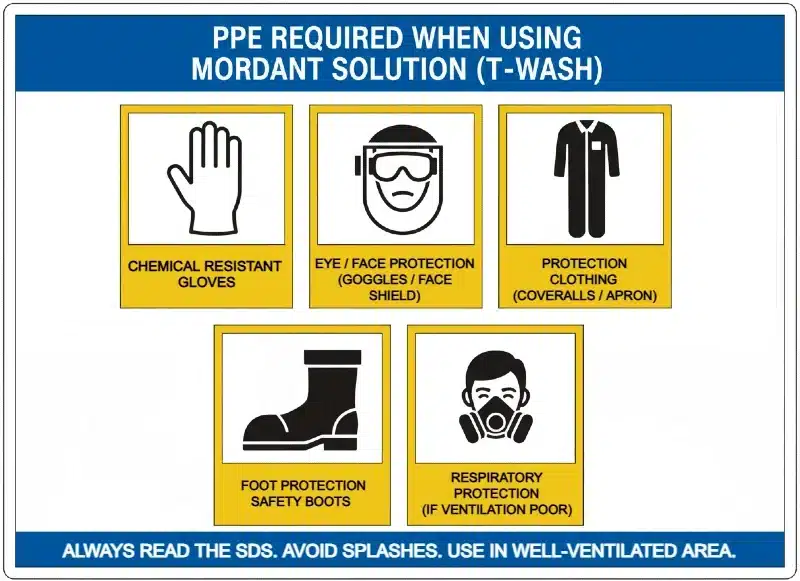
Always wear appropriate PPE when handling mordant solution including chemical-resistant gloves and eye protection
STEP-BY-STEP GUIDE
How to paint galvanised steel using mordant solution
Step 1: Inspect the galvanising (new, weathered, passivated?)
Look for:
- Bright, shiny zinc (typically new galvanising)
- White rust (zinc salts) or chalky residue
- Signs of passivation (often invisible, but shows up when T-Wash won’t react)
If there’s heavy corrosion, flaking coatings, or unknown contaminants, plan extra prep.
Step 2: Degrease properly (the step most people skip)
This is the biggest make-or-break step.
- Remove oils/grease thoroughly
- Change rags often
- If you suspect a stubborn factory film, use an abrasive pad after degreasing, then degrease again
Pro Tip: If you don’t degrease properly, the mordant solution may not blacken the surface and your paint system is at risk. This is the number one cause of failure on galvanised steel.
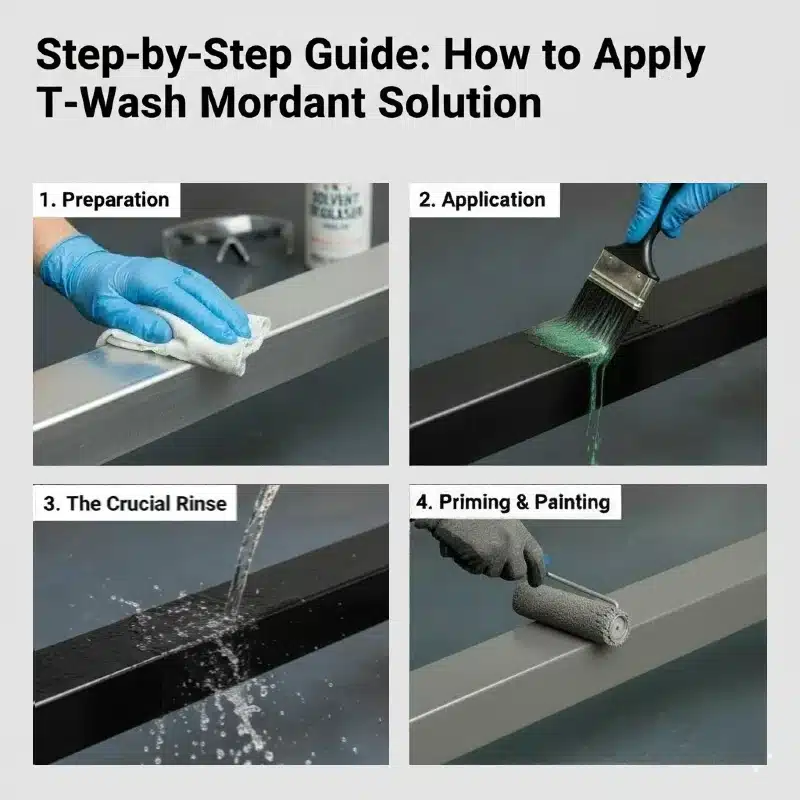
Step 3: Apply T-Wash and confirm the reaction
Apply the T-Wash mordant solution liberally with a brush or clean rag.
What you want to see: A consistent change from silver to dark grey/black.
If some areas don’t change colour:
- Treat it as a contamination/passivation warning
- Re-clean/abrade those areas and re-apply until you get a consistent reaction
Step 4: Rinse thoroughly and dry
Once the reaction has occurred:
- Rinse thoroughly with clean water to remove residues/salts
- Allow the surface to dry completely
Don’t rush this. Residues left behind can compromise adhesion.
Step 5: Prime and topcoat within the overcoat window
After the surface is treated, rinsed, and dry:
- Apply a suitable metal primer or a compatible direct-to-metal (DTM) coating
- Aim to prime/topcoat within the recommended window (commonly within 48 hours after prep) to avoid surface contamination returning
T-Wash mordant solution applied to galvanised steel showing the characteristic dark grey reaction
Troubleshooting: why it didn’t turn black (and what to do)
Grease/oil remains: Degrease again using fresh rags. Contamination is the most common reason for a failed reaction.
Passivator present: Lightly abrade the surface, degrease, then re-apply the mordant solution. Factory passivators are invisible but prevent the chemical reaction.
Cold/damp conditions: Results can be less reliable in cold weather. Improve drying, avoid wet surfaces, and extend dwell time cautiously.
Common mistakes that cause peeling on galvanised steel
- Painting new galvanising without a pre-treatment or suitable primer
- Skipping or rushing degreasing
- Not rinsing after mordant solution
- Leaving too long before priming (surface re-contaminates)
- Using an incompatible primer/topcoat system
Looking for the right pre-treatment?
Browse our industrial-grade Mordant Solution (T-Wash) – available for next-day delivery or in-store collection from Leigh, Greater Manchester.
Frequently Asked Questions
Palatine Paints Technical Team
With over 80 years in the coatings and chemicals industry, our technical team regularly advises trade and industrial customers on surface preparation and paint systems. Have a question about this guide? Get in touch or call us on 01942 884 122.