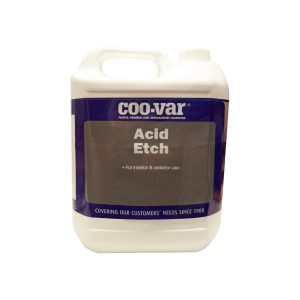
Acid Etch for Floors is a solution that prepares floors for painting fresh concrete that is less than six months old. Surface alkalinity needs to be neutralised by etching. This is down to the fact that high alkalinity is not ideal for single pack alkyd based paints. This is when cement floor etching is required.
Its main purpose is to remove surface laitance, (which is a fine layer that forms after the floor cures). This creates a porous substrate better known as a “key” for the paint to fully adhere to the floor that does not easily peel away from the surface.
Please note that if the floor etching does not start to foam at the concrete’s surface, the surface may be sealed or polished and will require light ablation in order to produce a porous surface
Acid Etch for Floors contains a diluted hydrochloric acid base that reduces the alkaline content of new concrete floors (the floor must be at least four weeks old) or create a key on very smooth floors. This allows the topcoat to adhere to the surface.
Apply with a watering can in a ribbon motion.
Scrub with a stiff bristle broom, especially heavily stain areas.
Wash off with a high powered hose.
Sweep excess water and allow to completely dry.
This creates a profile for the coating to adhere to, and prevents peel up.
Preparation
Acid etching is a chemical process that requires the surface to be properly “prepped” before the reaction can occur.
Surface Cleaning: The floor must be free from dust, dirt, grease, oil, and other contaminants. Acid will not penetrate through grease; use an industrial degreaser first if necessary.
Pre-Wetting: Before applying the acid, uniformly wet the concrete surface with clean water. The concrete should be damp but without any puddles or standing water.
Age of Concrete: Ensure the concrete is at least four weeks old. For concrete less than six months old, etching is vital to neutralize surface alkalinity.
Test Patch: If the acid solution does not begin to foam upon contact, the surface may be sealed or polished. In these cases, mechanical abrasion (grinding) is required to make the surface porous enough for the acid to work.
Application
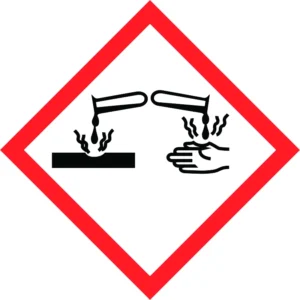
This product contains hydrochloric acid. Handle with care and ensure the area is well-ventilated.
Mixing/Thinning: Dilute at a ratio of 3 parts clean water to 1 part Acid Etch.
Safety Rule: Always add the acid to the water, never the water to the acid.
Method: Apply the diluted solution uniformly using a plastic watering can (in a ribbon motion) or an acid-tolerant pump unit.
Agitation: While the solution is on the floor, scrub it vigorously into the concrete using a stiff bristle broom or brush.
Reaction Time: Allow the solution to remain on the surface for as long as it continues to bubble and foam (typically 2–10 minutes).
Rinsing: Once the bubbling slows down, flush the entire surface with large amounts of clean water to completely remove and neutralize the acid. Use a high-powered hose or pressure washer if possible.
pH Verification: Check the pH level of the wet surface using pH paper.
* Target: pH 7.0 (neutral).
* Acceptable Range: 6.0 – 9.0.
* Action: If the pH is below 6.0, residual acid remains; rinse again and re-test.
Drying: Sweep away excess water and allow the floor to dry 100% (usually 24–48 hours) before painting.
Final Sweep: Once dry, vacuum or brush the surface to remove any final traces of “laitance” or powdery residue loosened by the etch.
Clean Up: Thoroughly flush all application equipment (watering cans, brushes) with water immediately after use.
Tip: A successful etch will leave the concrete with a texture similar to fine-grit sandpaper. If the surface still feels smooth, the process may need to be repeated.
Pack Sizes: 5 Litre and 20 Litre.
Coverage / Drying Times
Surface Dry: Not applicable (The solution must be washed off while reacting/bubbling, typically within 2–10 minutes).
Hard Dry: Not applicable (The floor must be allowed to dry completely after rinsing before any paint is applied; this usually takes 24–48 hours depending on ventilation).
Overcoat: Floor must be 100% dry and the pH level checked (ideal pH 7.0) before applying the first coat of paint.
Theoretical Coverage: Approximately 40m² – 50m² per 5L unit (when diluted at the recommended 3:1 ratio with water).
Thinning and Cleaning
Thinning: Dilute 3 parts clean water to 1 part Acid Etch. Always add the acid to the water, not the water to the acid.
Cleaning: Flush the surface and all application equipment (watering cans/brushes) thoroughly with plenty of clean water immediately after use to neutralise the acid.
Q: What is the primary function of Palatine Paints Acid Etch for Floors?
A: This product is a chemical solution designed to prepare concrete surfaces for painting by removing surface laitance—a weak, dusty layer that forms during the curing process—and creating a textured “key” or profile for the paint to bond to.
Q: When is it necessary to use an acid etch treatment?
A: Acid etching is essential for new concrete floors that are less than six months old, very smooth or power-floated concrete surfaces, and floors with high alkalinity that could otherwise cause paint to peel or fail.
Q: Can this product be used on previously painted surfaces?
A: No, acid etch is only effective on bare concrete or mortar; it will not react with or remove existing paint, so any previous coatings must be mechanically removed or thoroughly abraded before treating the underlying concrete.
Q: How do I know if the acid etch is working correctly?
A: Upon contact with the concrete, the solution should begin to foam or bubble vigorously, indicating that the acid is successfully reacting with the minerals in the surface to create a profile.
Reviews
There are no reviews yet.
Be the first to review “Acid Etch for Concrete” Cancel reply
To provide the best experiences, we and our partners use technologies like cookies to store and/or access device information. Consenting to these technologies will allow us and our partners to process personal data such as browsing behavior or unique IDs on this site and show (non-) personalized ads. Not consenting or withdrawing consent, may adversely affect certain features and functions.
Click below to consent to the above or make granular choices. Your choices will be applied to this site only. You can change your settings at any time, including withdrawing your consent, by using the toggles on the Cookie Policy, or by clicking on the manage consent button at the bottom of the screen.
Functional
Always active
The technical storage or access is strictly necessary for the legitimate purpose of enabling the use of a specific service explicitly requested by the subscriber or user, or for the sole purpose of carrying out the transmission of a communication over an electronic communications network.
Preferences
The technical storage or access is necessary for the legitimate purpose of storing preferences that are not requested by the subscriber or user.
Statistics
The technical storage or access that is used exclusively for statistical purposes.The technical storage or access that is used exclusively for anonymous statistical purposes. Without a subpoena, voluntary compliance on the part of your Internet Service Provider, or additional records from a third party, information stored or retrieved for this purpose alone cannot usually be used to identify you.
Marketing
The technical storage or access is required to create user profiles to send advertising, or to track the user on a website or across several websites for similar marketing purposes.









Reviews
There are no reviews yet.